
Compliance guide
Miami-Dade grease (FOG) permit: who needs one and what it requires
Any non-residential Miami-Dade facility that handles, prepares or processes food and can discharge grease to the public sewer needs a FOG Discharge Control operating permit from DERM, renewed every calendar year [1]. The permit sets your cleaning schedule, a DERM-permitted hauler does the cleaning, and you keep three years of records on site [4].
Last reviewed 11 official sources
Key takeaways
- Restaurants, cafeterias, supermarkets, schools, banquet halls and food courts are typical FOG generators that need the permit [1].
- You apply through the County's Certificate of Use portal; the permit is renewed every calendar year and a new owner needs a new permit [1][3].
- The County's baseline is monthly cleaning for hydromechanical interceptors and every 60 days for gravity interceptors, sooner if grease and solids reach 25% of the depth [4].
- Only a DERM-permitted liquid waste transporter may clean your interceptor, and each pump-out is reported online by the 20th of the following month [4][5].
- Keep maintenance, service and training records on site for at least three years; off-site records do not count [4].
- DERM has recommended changes to the FOG rules in 2026; confirm current requirements with DERM before you act [10].
At a glance
- Who issues it
- Miami-Dade DERM (RER); also called a GDO permit [9]
- Legal basis
- Miami-Dade Code Secs. 24-18 and 24-42.6 [3]
- Permit term
- January 1 – December 31, renewed annually, non-transferable [1]
- Baseline cleaning
- Hydromechanical: monthly. Gravity: every 60 days. Sooner at the 25% FOG capacity limit [4]
- Pump-out reporting
- Online, on or before the 20th of each month [5]
- Records
- On site, at least 3 years [4]
- Permit fee (from Oct. 1, 2026)
- $173.14 to $769.50 by floor area [8]
Who needs a DERM FOG permit, and the legal basis
Miami-Dade County requires a Fats, Oils and Grease (FOG) Discharge Control operating permit for any non-residential facility that handles, prepares or processes food, hot or cold, and discharges or could discharge fats, oils or grease to the public sanitary sewer [1]. The County calls these facilities FOG generators. Its own examples are restaurants, cafeterias, supermarkets, schools, banquet halls and food courts at malls or shopping centers [1]. The permit is also required for facilities on a septic system located in a wellfield protection area, and the County's FOG page notes it is also referred to as a GDO permit [9].
The permit application guidelines cite Sections 24-18 and 24-42.6 of the Code of Miami-Dade County as the regulatory basis [3]. Section 24-42.6, the FOG Control Program, was created by an ordinance the Board of County Commissioners adopted on February 21, 2018 [4]. Its definition of FOG generator goes beyond restaurants to include bakeries, hotel and cafeteria kitchens, commercial kitchens, kitchens serving hospitals, nursing homes, daycares and assisted living facilities, and food processing plants [3].
Your sewer bill and your grease permit are separate matters. Whoever provides your sewer service, the FOG rules cover discharges to both utility and non-utility sewer systems, and the permit comes from DERM [4]. The two do connect: if a facility fails to stop a prohibited discharge, the code lets DERM order it to stop operating or order the utility that provides its water service to cut that service off [4]. The County's FOG page explains that its sewer system is under a federal court order, and that the settlement requires the County to reduce grease in its sewer pipes [9].
How to apply, renew and what it costs
- 01
Get your city approvals moving
If the facility is inside a city, you must first apply for that city's occupational license and/or Certificate of Use. That license does not need to be finalized before you apply for the FOG permit [1].
- 02
Apply through the County portal
Submit the FOG application through the County's online portal, choosing the Certificate of Use option [1]. The application lists every FOG control device by make, model, material, capacity and location, and the County will not issue a permit until the device is approved [3].
- 03
Pay the fees
Fees are invoiced and collected as part of the Certificate of Use review [3]. The County accepts Visa, MasterCard, Discover and e-checks [1].
- 04
Post the permit
The County won't accept an incomplete application. The permit document, which must be posted at the facility, is usually mailed within 30 days after a complete application is processed and approved [1].
- 05
Renew every year
The permit is valid from January 1 to December 31. The County sends renewal forms at least 45 days before it expires [1]. Each year the facility must also submit a FOG control device certification. A Florida Professional Engineer, licensed plumber or liquid waste transporter prepares it, confirming the device is working as designed [4].
| Fee item | Amount |
|---|---|
| FOG generator, 4,000 sq. ft. or less | $173.14 |
| FOG generator, 4,001 to 20,000 sq. ft. | $346.28 |
| FOG generator, more than 20,000 sq. ft. | $769.50 |
| FOG control device operator | $307.80 |
| Re-inspection (second re-inspection and after) | $76.95 |
The fee schedule states these operating permit fees run through September 30, 2027, and then rise each October 1 with the Consumer Price Index [8]. Confirm the amount on your invoice with DERM.
What the permit requires day to day
Your permit conditions are your rulebook. The County's fact sheet tells operators to know their permit conditions, train staff on them and post them in a visible place [2]. Under Section 24-42.6, permits for new FOG generators and their renewals include these conditions [4]:
- Keep every FOG control device serviced so it works properly and continuously [4].
- When cleaning is required, remove the full contents: settled solids, wastewater and floating grease. Walls, baffles, cross-pipes and inlet and outlet pipes must be pressure washed or scraped. Decanting, skimming or backflushing as a cleaning method is prohibited [4].
- Don't use emulsifiers, grease cutters or other chemicals that could push grease through to the drains [4]. The fact sheet adds that hot water does not get rid of FOG [2].
- Inspect yellow and brown grease storage containers daily and empty them before they reach 90 percent capacity. Keep lids on to stop rainwater getting in, and lock them [4].
- Grease removed when drains are jetted or rodded, and waste from manual hood cleaning, must be collected and hauled away by a DERM-permitted liquid waste transporter, not flushed to the sewer [4].
- Keep at least one trained person on staff. Training covers orientation for new employees and quarterly training for existing staff [4].
- Report pump-outs to DERM and keep records on site, as described below [4].
Who sets pump-out frequency, and the 25% rule
Your required cleaning frequency comes from your permit, and the permit follows Section 24-42.6. The code sets a baseline by device type and requires cleaning sooner whenever the FOG capacity limit or the oil and grease discharge standard would be exceeded [4]. The code defines the FOG capacity limit as combined grease and solids reaching 25 percent of the device's design hydraulic depth at any point. For devices rated by third-party certification, the limit is 75 percent of the rated FOG and solids capacity [4]. The County's electronic reporting guide gives the oil and grease standard as 150 mg/L [5].
| Device | Baseline cleaning by a DERM-permitted hauler | Notes |
|---|---|---|
| Manual hydromechanical interceptor | Monthly, or more often if needed | Staff may remove floating grease and solids between hauler visits [4] |
| Automatic hydromechanical interceptor | Monthly, or more often if needed | Strainer and storage container emptied daily by staff; if the automatic parts fail, the hauler cleans it daily until repaired [4] |
| Gravity interceptor | Every 60 days, or more often if needed | With a working interceptor monitoring device: up to 180 days [4] |
| Alternative schedule | Approved by DERM | For hydromechanical units, not to exceed 90 days, based on an engineering analysis or field study [4] |
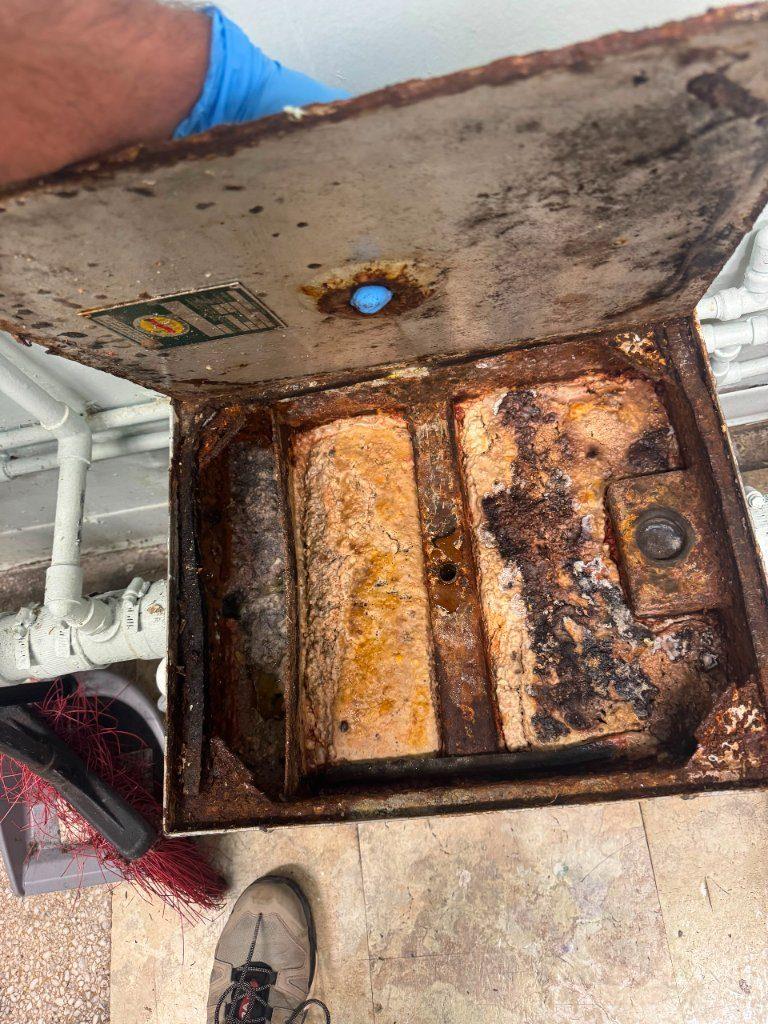
The fact sheet also lists signs that a device needs pumping between scheduled visits: grease overflowing out of the trap, pipes you can no longer see (in some trap types), a grease layer that has turned almost solid and grey or black, drains backing up, or several months since the last pump-out [2].
Grease trap vs. interceptor, sizing and approval
In everyday use, a grease trap is a small unit in the kitchen and an interceptor is a large tank in the ground. The County's documents use one umbrella term, FOG control device, and the code says a grease interceptor means a FOG control device [4]. The fact sheet describes a grease trap as a concrete or metal tank where grease separates and floats until a certified liquid waste hauler removes it [2]. The code then splits devices into two main types [4]:
- Gravity grease interceptor: relies on the difference in specific gravity between wastewater and grease to separate them. These are typically the large in-ground tanks [4].
- Hydromechanical grease interceptor: third-party tested and certified, and may use flow control or air entrainment to improve separation. The minimum size is 20 gallons per minute [4].
Sizing and approval run through DERM. Devices are sized for every user and tenant they serve, using the Florida Building Code or calculations by a Florida Professional Engineer, and DERM must approve the sizing [4]. Plans must be signed and sealed by a Florida Professional Engineer [4]. They must show every back-of-house fixture connected to the device, at least one accessible sampling point, and at least four feet of vertical and three feet of horizontal clearance for cleaning [4]. Dishwashers must connect to a FOG control device, and no pump or ejector that can emulsify grease may feed one [4]. A single above-grade unit may be approved only when below-grade installation isn't physically possible and the unit is rated at 25 gallons per minute or less [4].
Using a DERM-permitted hauler, manifests and online reporting
Only a liquid waste transporter permitted by DERM may collect, pump or transport grease in Miami-Dade [4]. Having your device cleaned by an unpermitted person, or using an unpermitted transporter, is a listed cause for revoking your FOG permit [4]. The County publishes lists of transporters with valid permits by waste type, including brown grease (grease interceptor waste). Those lists update overnight and may not be current when you view them [6]. The fact sheet suggests emailing DERMPRED@miamidade.gov or calling 305-372-6820 for a current list of grease trap haulers [2].
Every load is documented on the County's FOG Single Load Liquid Waste Transporter eManifest [6]. For each facility pumped, the form records the GDO number, device capacity and wet volume, the measured grease and sludge layers, and whether grease was found in the outlet. It also records whether the outlet device is missing or damaged and whether the tank is breached, along with the hauler's DERM decal number and the disposal facility's certification [7]. The hauler must assess the device's condition at each required cleaning, including water level, grease and solids thickness and leaks. Haulers report manifests online no later than 20 days after the end of the month [4].
You report too. Since January 2018, permitted facilities report each pump-out date and the service provider's name online, on or before the 20th of each month [5]. You need your GDO permit number and the hauler's LW operating permit number [5].
What records to keep, for how long, and where
Section 24-42.6 requires FOG generators to keep records of maintenance and repairs, service calls and staff training. Records must stay on site for at least three years and be shown to DERM staff on request, and off-site records are not an acceptable substitute [4]. At a minimum, the code lists [4]:
- Scheduled and unscheduled service calls to clean grease waste drains, building drains or building sewers [4]
- Repairs needed because of food or grease buildup or blockages [4]
- Kitchen exhaust hood cleaning [4]
- FOG control device cleaning, maintenance and repair [4]
- Waste manifest forms [4]
- Staff training records [4]
The fact sheet adds: keep all receipts of grease trap pump-outs and maintenance activities [2]. The code says records are kept on forms prescribed by DERM [4]. The County's electronic reporting guide points to a grease trap maintenance log form [5], but that link returned "page not found" when this guide was reviewed. Ask DERM for the current version.
Inspections, violations and enforcement
DERM doesn't publish a step-by-step inspection checklist in these sources, but the rules show what an inspector needs to see. Keep access panels and manholes clear so staff and DERM inspectors can reach the device [2]. The sampling point must be accessible for visual inspection and sampling [4], and your on-site records must be ready to show [4]. The fact sheet invites operators to ask the DERM inspector for help during the inspection [2]. A re-inspection fee applies from the second re-inspection onward [8]. For complaints, compliance inspections and enforcement questions, the County lists FOGcompliance@miamidade.gov and 786-315-2424 [9].
- Prohibited discharge: stop it immediately and submit a corrective action plan within 30 days of DERM's determination [4].
- Breached device: temporary repairs within 7 days, plans for a new device within 30 days, and an approved device installed within 90 days [4].
- Failure to stop a prohibited discharge: DERM may direct the facility to stop operating or order the water utility to stop service [4].
- Permit revocation: causes include falsifying records, not cleaning on time or properly, using an unpermitted cleaner or transporter, breaking permit conditions, and unpaid fees or fines. Revocation comes on top of any other penalties under the County Code [4].
- Notice of Violation: the County fee schedule lists a case processing fee of $513.00 related to a DERM Notice of Violation [8].
- Closing the business: the property owner must request a closure inspection within 30 days, with grease containers emptied and devices cleaned [4].
How Clear Line fits in
We handle the hands-on side of the permit: the pump-outs, the paperwork from each visit, and a schedule that matches the frequency on your permit. You stay the permit holder and do your own online reporting. We just make sure you have what you need to do it.
- A full pump-out every visit: floating grease, wastewater and settled solids removed, with walls, baffles and tees scraped. No skimming or decanting.
- A manifest for every pump-out, with the measurements and condition notes from the visit.
- Our permit and decal details on hand, so your monthly report takes a couple of minutes.
- Photos and notes when we find a damaged outlet tee, a missing baffle or signs of a leak, so you can act before an inspection.
- A paper copy for your on-site binder, because the County doesn't accept off-site records as a substitute.
- Emergency grease trap response when a backup can't wait for the next scheduled visit, plus line jetting through our Partner Network, all with one call.
Miami-Dade FOG permit checklist
- Current FOG (GDO) operating permit posted at the facility
- Permit conditions read, and the cleaning frequency on the permit noted on the calendar
- Renewal form watched for (sent at least 45 days before December 31) and fees paid on time
- Annual FOG control device certification submitted by an engineer, licensed plumber or liquid waste transporter
- Hauler is on DERM's current permitted brown grease transporter list
- Manifest received and filed for every pump-out
- Each pump-out reported online by the 20th of the month (GDO number and hauler's LW permit number at hand)
- Three years of maintenance, service-call, hood-cleaning, repair and training records kept on site
- At least one trained staff member; new-hire orientation and quarterly training logged
- Access lids, manholes and the sampling point clear for inspectors
- Grease containers checked daily, emptied before 90% full, lids closed and locked
- No enzymes, degreasers or grease cutters poured into drains or the trap
- DERM notified before a sale, relocation or change of ownership
Frequently asked questions
Does my restaurant need a DERM grease permit?
Yes, if it is a non-residential facility in Miami-Dade that handles, prepares or processes food and discharges, or could discharge, grease to the public sanitary sewer. The County lists restaurants, cafeterias, supermarkets, schools, banquet halls and mall food courts as typical examples.
How often does Miami-Dade require a grease interceptor to be pumped?
Your permit sets the schedule. Under Section 24-42.6, the baseline is monthly for hydromechanical interceptors and every 60 days for gravity interceptors, or sooner if grease and solids reach the 25% capacity limit or the discharge standard would be exceeded. DERM can approve alternative schedules.
What is the 25% rule?
The code defines the FOG capacity limit as grease and solids together reaching 25 percent of the device's design hydraulic depth anywhere in it. For devices rated by third-party certification, it's 75 percent of the rated capacity. Reaching that limit means the device has to be cleaned, even if a scheduled visit isn't due yet.
Can I clean my own grease trap?
Only if you meet every condition of the exception: an interceptor rated at 20 gallons per minute or less, no fryers, no Type I hood required, and daily cleaning. You also have to stay within the 150 mg/L standard and cause no sanitary nuisance. Self-cleaners keep paper logs on site for three years and report SELF CLEANING online. Everyone else must use a DERM-permitted transporter.
How long do I keep grease trap records, and where?
At least three years, on site. Off-site records are not an acceptable substitute. Keep manifests, cleaning and repair records, service calls, hood cleaning and staff training records ready to show DERM staff on request.
How much does the FOG permit cost?
The County fee schedule effective October 1, 2026 lists $173.14 for facilities of 4,000 sq. ft. or less, $346.28 for 4,001 to 20,000 sq. ft., and $769.50 above 20,000 sq. ft.. Fees are invoiced through the Certificate of Use process.
I'm buying an existing restaurant. Does the permit come with it?
No. FOG permits can't be transferred, and a new owner must get a new permit. The County must be notified of the sale, relocation or transfer. The seller or landlord must also disclose the FOG generator under Section 21-49.2 of the County Code.
Are Miami-Dade's grease rules changing?
Possibly. In October 2026 the County Commission approved a DERM report recommending changes to make the FOG rules less costly for businesses, and DERM is vetting code changes. Until changes are adopted, the current permit conditions and code apply. Check with DERM before changing your schedule.
Sources
Official sources. Bracketed numbers in the text point to this list.
- [1]Fats, Oils and Grease (FOG) Discharge Control Operating Permit · Miami-Dade County RER / DERM
- [2]FOG - Fats, Oils and Grease (fact sheet) · Miami-Dade County DERM
- [3]Fats, Oil & Grease Discharge Control - Operating Permit Application and Submittal Guidelines (REV. 07/07/2023) · Miami-Dade County RER / DERM
- [4]Ordinance No. 18-22 (Legislative File 180026), creating Sec. 24-42.6, FOG Control Program · Miami-Dade County Board of County Commissioners
- [5]Grease Discharge Operating (GDO) Permit Electronic Report guide (04-16-2026) · Miami-Dade County DERM
- [6]Liquid Waste Transporter Permit (includes permitted transporter lists) · Miami-Dade County RER / DERM
- [7]Fats, Oils and Grease (FOG) Single Load Liquid Waste Transporter eManifest (form) · Miami-Dade County DERM
- [8]Implementing Order 4-42 — Fee schedule for RER and DERM services (effective Oct. 1, 2026) · Miami-Dade County
- [9]Fats, Oils and Grease (FOG) — non-residential facilities and compliance · Miami-Dade County RER
- [10]Miami-Dade County proposes updates to environmental regulations for local businesses (Oct. 7, 2026) · Miami-Dade County
- [11]Resolution R-128-26 (File 260336) directing a study of the County's FOG regulations · Miami-Dade County Board of County Commissioners
This guide summarizes public rules to help owners and managers. It is not legal advice. Rules change: always confirm with the agency that issues your permit.
Get a free quote
Who needs a Miami-Dade DERM grease (FOG) permit, what it requires, how often to pump, which haulers to use and which records to keep on site.