
Compliance guide
Private lift stations in Miami-Dade: PSO permit, service agreement and RTU
If your property owns or operates a private sewer system in Miami-Dade, DERM regulates it through a Private Sanitary Sewer Operating (PSO) permit valid for one year [1]. Pump stations also need a signed service agreement with quarterly inspections and 4-hour overflow response [3], monthly elapsed-time readings [2], and an RTU that alerts on alarms in real time [4].
Last reviewed 6 official sources
Key takeaways
- The PSO permit covers all privately owned or operated sanitary sewers in Miami-Dade and is valid for one year [1].
- DERM must approve an executed service agreement that commits to inspections at least quarterly and a 4-hour response to overflows [3].
- Every private pump station needed an approved RTU by October 1, 2022; new stations must install one before final certification [4].
- Pump elapsed-time (ET) readings are due online by the 14th of the following month, and DERM will start enforcement if they are not filed [2].
- Keep a logbook of all service and repairs and an O&M manual at the control panel or the management office [2].
- Pumping out the wet well does not replace temporary pumps when a pump fails [3].
At a glance
- Permit
- Private Sanitary Sewer Operating (PSO) permit, Miami-Dade DERM [1]
- Valid for
- One year [1]
- Pump station fee (application schedule)
- $175.00 per station, plus pipe fees if applicable and a 7.5% county surcharge; DERM confirms the amount [2]
- Minimum inspection
- No less than quarterly, by a duly licensed professional [3]
- Overflow response
- Within 4 hours of the overflow being identified [3]
- ET readings
- Monthly, by the 14th of the following month [2]
- RTU deadline (existing stations)
- October 1, 2022 [4]
- PSO program contact
- 305-372-6920, PSO@miamidade.gov [2]
What counts as a private pump station, and who holds the permit
Miami-Dade County uses the Private Sanitary Sewer Operating (PSO) permit to monitor and regulate all privately owned or operated sanitary sewers in the county [1]. That covers the gravity pipes and manholes on a property as well as any pump station (lift station) that pushes the property's sewage into a utility system. DERM's pump station numbering shows the split: a station's number starts with a two-digit owner code, and code 99 means a private owner, as opposed to a city or the Water and Sewer Department [5].
The permittee is the property owner. The application asks for the owner's name exactly as recorded with the Florida Division of Corporations and in the Property Appraiser's records, and for an officer as contact when someone else signs [2]. A condo association, HOA or plaza owner is therefore the permit holder, even when a management company handles the paperwork. The permit is non-transferable, and the owner must notify DERM upon sale, change of location or legal transfer [2].
The legal basis is Chapter 24 of the Miami-Dade County Code. As DERM quotes it, Section 24-42.2(5) requires non-utility collection systems to be maintained to prevent or minimize overflows, to have a written maintenance plan covering inspection, preventive and corrective maintenance and reporting procedures, and to have pump stations with fully operable alarm or monitoring equipment that reports high wet-well levels and power failures [4]. That section was amended under a federal consent decree effective December 6, 2013 to reduce sanitary sewer overflows from private systems [4].
How to apply for and renew the PSO permit
A new private sewer system first needs a Permit to Construct a Domestic Wastewater Collection/Transmission System, also called a Sewer Extension permit; for an existing system no other permit is required [1]. A complete application is the Permit Application Form, the Annual Report Form and the permit fee, and DERM says a properly completed application can be processed immediately [1]. The permit is valid for one year [1].
- 01
Gather owner and site details
Owner name as registered, officer contact, two required email addresses, facility address and all property tax folio numbers [2].
- 02
Name your emergency contact and contractor
A 7-day/24-hour emergency contact and the maintenance contractor's company name and phone. The contractor's phone number must appear on the pump station emergency sign [2].
- 03
Attach the service agreement and O&M manual
The application asks whether the service agreement is attached and asks for a copy of the operations and maintenance manual [2].
- 04
List the system inventory
Pipe length by diameter (including laterals), number of manholes and existing or new pump stations, consistent with the system drawing [2].
- 05
Sign and pay
The owner or a representative with a notarized letter signs; DERM staff then advise the fee due, payable by check or online [2].
- 06
Renew each year
Bill renewals and ownership changes for existing permits go through 305-372-6600; ownership or corporate name changes need the notification form [1].
On fees, DERM's page says the amount depends on the total length and size of the private sewer pipe and the number of private pump stations, under a schedule approved by the Board of County Commissioners [1]. The application's fee table lists $175.00 per pump station; pipe fees of $0.12, $0.20 and $0.26 per linear foot for 6-inch, 8-inch and larger pipe apply only if the facility has more than 1,000 linear feet of pipe 6 inches or larger; 4-inch pipe is not charged; and a 7.5% county surcharge is added [2]. Treat these as the published schedule and confirm the amount with DERM, which tells each applicant what is due [2].
The required service agreement, item by item
A service/maintenance agreement between the permittee and the company servicing the private system is required, and an executed copy goes to DERM for approval [3]. New systems submit it with the Sewer Extension certification of completion [3]. The pump station requirements do not apply to PSO permits that cover only a collection system without pump stations [3].
| Required item | What it means in practice |
|---|---|
| DERM PSO permit information | Permit number, pump station number(s), owner name, title, phone, email and facility address [3] |
| Inspection frequency | Collection and transmission system inspected/serviced no less than quarterly, 4 inspections per year [3] |
| Overflow response | Sanitary sewer overflows addressed by the contractor within 4 hours of being identified [3] |
| ET reading statement | Contractor or another authorized person reports pump ET readings monthly before the 14th of the following month [3] |
| Hauling and disposal | Pump-outs by a DERM-permitted liquid waste hauler, disposed at a DERM-permitted facility; hauler and its DERM LW permit number named; manifests available on request [3] |
| RTU installer and maintainer | Name of the agency or entity that installed the RTU and the one that maintains it [3] |
| RTU alarm statement | Statement that the contractor will receive and respond to any and all RTU alarm notifications [3] |
| Maintenance schedule | Exhibit A minimum preventive maintenance schedule, or more frequent work [3] |
| Signature | Signed and dated by the permittee/owner or an authorized representative [3] |
- If the contractor's main office is outside Miami-Dade, documentation of its ability to respond to an overflow within 4 hours must be submitted with the agreement [3].
- If you change contractors, notify DERM within 15 days of the change and submit the new executed agreement [3].
- Any request to modify or update PSO permit information must include a copy of the agreement [3].
RTU telemetry: who needs it and what it must report
All pump stations must be continuously monitored with a remote telemetry unit (RTU) or an equivalent system meeting Section 24-42.2(5) [3]. Existing facilities had until October 1, 2022, with one RTU for each pump station; new stations must show the RTU in construction documents and install it before final certification [4]. A station that already has an operable, DERM-approved RTU does not need a new one, but replacements must meet the current guidelines [4].
| # | Alarm point |
|---|---|
| 1 | Pump station power failure |
| 2 | Pump 1 fail |
| 3 | Pump 2 fail |
| 4 | Pump 3 fail (as applicable) |
| 5 | High water level alarm, set no less than six inches below the inflow invert |
| 6 | Pump station control panel alarm activation |
| 7 | Spare point 1 for future use |
| 8 | Spare point 2 for future use |
- Wireless over a cellular or satellite network with real-time alerts to the owner and the service contractor [4].
- Alerts by text message and email, including DERM's PSO inbox, PSO@miamidade.gov [4].
- A 24-hour backup battery for loss of 120 VAC power, wired so a power interruption triggers the power-failure alarm [4].
- Enclosure rated NEMA 1 indoors and NEMA 4X or IP67 outdoors; other enclosures need DERM approval of cut-sheets first [4].
- At existing stations, the bottom of the unit at least 36 inches above finished ground unless the building permit says otherwise [4].
- Waterproof label reading "RTU-Pump Station #" on a tamperproof, key-locked panel [4].
- Monitoring set-up includes the DERM pump station number matching the emergency contact sign, plus phones and emails of the contractor, the owner and DERM's PSO inbox [4].
Installation must be done by a licensed contractor with building permits pulled first and Sunshine 811 clearance where digging is needed [4]. Once the unit works, the owner or contractor requests a PSO compliance inspection at PSO@miamidade.gov and demonstrates the RTU; compliance requires a passed inspection, and a failed one that needs a repeat visit carries a $75.00 re-inspection fee [4].
Inspections, alarm response and records
Pump stations must be inspected no less than quarterly by a duly licensed professional for preventive maintenance, including removing floating and deposited solids from the wet well, and for repairs [3]. The gravity collection system also needs a quarterly inspection to find deficiencies that could cause surcharging or overflows [3]. Exhibit A of DERM's requirements sets the minimum preventive schedule the agreement must include:
| Equipment | Activity | Minimum frequency |
|---|---|---|
| Pump motor | Lubricate bearings; measure insulation resistance | Semiannually |
| Pump motor | Check running amperes | As needed, min. annually |
| Pumps | Check and lubricate bearings; check outflow pressure | As needed, min. quarterly |
| Floats | Clean | As needed, min. quarterly |
| Control panel | Check for tripped breakers and test alarm; check for corrosion | Quarterly (alarm test as needed, min. quarterly) |
| Electrical | Check indicator and alarm lamps | Monthly or min. quarterly |
| Check valve | Check / exercise | Quarterly / annually |
| Gate valve | Lubricate | Annually |
| Hatch cover and surrounding area | Check, clean and maintain | Monthly or min. quarterly |
| RTU | Wireless connection in working condition | Monthly |
| PSO emergency contact sign | Replace damaged sign or phone number | As needed, min. quarterly |
- ET readings: submit elapsed-time readings through DERM's online ET filing application by the 14th of the following month; the PSO permit's Specific Condition No. 2 requires them [2].
- Logbook: record all service, maintenance and repairs, kept protected from the weather in the control panel or the property management office [2].
- O&M manual: kept at the control panel protected from the weather or readily available at the facility office [2].
- Hauler records: keep copies of liquid waste hauler manifests and the hauler's DERM permit available on request [3].
What triggers violations, and reporting overflows
DERM's documents name specific triggers. Failing to submit ET readings leads to enforcement action [2]. Deficiencies and Code violations in the collection and transmission system must be fixed within the timeframes in the Notice DERM issues [3]. RTU compliance requires a passed inspection [4]. The application also warns of significant penalties, including fines and imprisonment, for knowingly submitting false information [2]. DERM's materials we reviewed do not publish a fine schedule for PSO violations, so ask DERM if you receive a notice.
If a deficiency causes a sanitary sewer overflow (SSO), the permittee must address the cause and start repairs, including emergency bypass pumps and/or pump-out service, within 4 hours of the overflow being identified, and keep bypass pumps running until the system is back in compliance [3].
At the state level, the Florida Department of Environmental Protection says a spill should be reported by the owner or operator as soon as practical, within 24 hours of discovery [6]. Spills over 1,000 gallons, or any that may threaten the environment or public health, go to the State Watch Office at 1-800-320-0519; smaller spills with no threat go to the DEP district office or delegated local program [6]. A written report is due within 5 days of discovery [6]. DERM's PSO documents we reviewed do not set a separate reporting form, so also tell the PSO program (305-372-6920, PSO@miamidade.gov) and confirm what they need [2].
Broward and Palm Beach
The PSO program above is a Miami-Dade County program. We could not confirm an equivalent countywide operating permit for private lift stations in Broward or Palm Beach from official sources at the time of review. In those counties, requirements for privately owned lift stations depend on the city or utility that receives the flow and on county construction licensing. Before you sign a maintenance contract there, ask your utility and your county environmental office what operating permit, service contract, alarm and record rules apply to your station.
What a good maintenance program looks like
The rules set a floor. This is the operational practice we recommend on top of it; it is advice, not a regulation. Stations serving restaurants, laundries or high-occupancy buildings usually need visits more often than quarterly because grease and wipes build up faster.
- Clean and test every float or level sensor at each visit, lifting each one by hand to confirm pump start, stop, lead/lag and high-level alarm.
- Record amperage and run hours per pump each visit; a rising amp draw or one pump running far more than the other points to wear or a clog.
- Vacuum the wet well before grease mats and debris reach the floats, and scrape the walls and rails while it is empty.
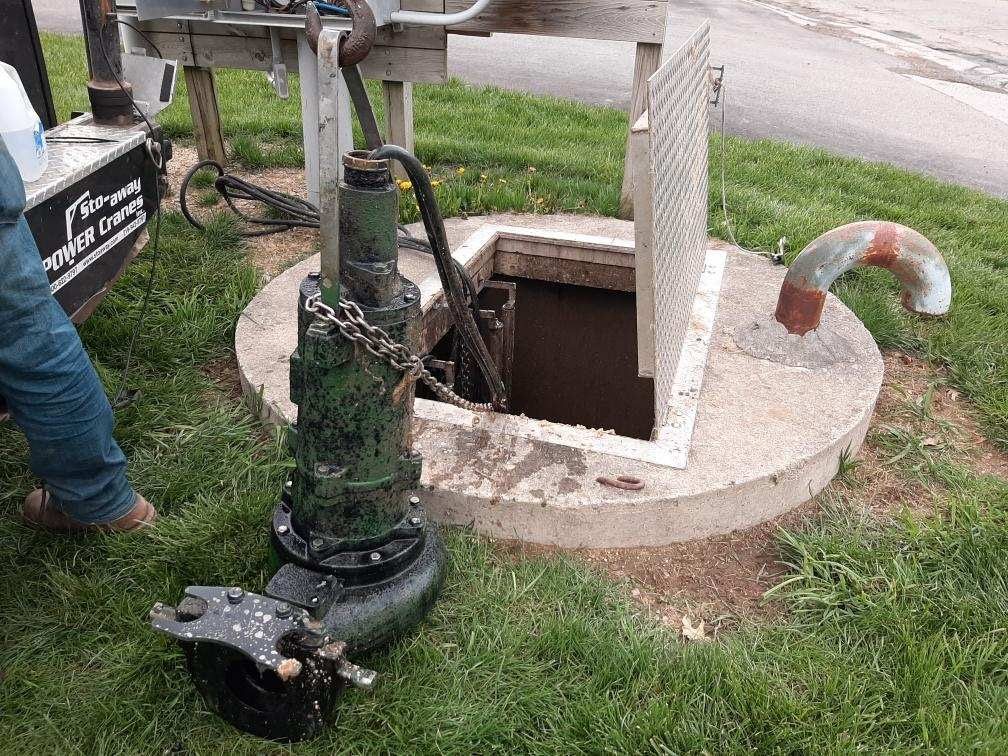
- Pull each pump on a planned schedule to inspect the impeller, seals, cable and guide-rail fit, rather than waiting for a failure.
- Trigger the high-level alarm and confirm the RTU text and email arrive at every listed phone and inbox.
- Check the control panel for moisture, corrosion and loose terminals, and keep the emergency sign legible.
- Hydro-jet the incoming gravity lines when solids keep returning to the wet well.
- Write every visit into the logbook the same day, with readings and photos.
How Clear Line fits in
Clear Line and our Partner Network take care of lift stations for condo associations, HOAs, plazas and commercial sites. For a Miami-Dade PSO station, the licensed maintenance contractor from our network signs the DERM service agreement; we coordinate everything else. That contractor runs the quarterly or more frequent visits, pumps the wet well and takes the readings that go into your logbook and ET filing. Our part is coordination. We check the agreement against DERM's listed items and Exhibit A before it goes to you, keep the visits on schedule, collect the reports, take RTU alarm calls on our 24/7 line and send a crew, and send you one invoice. If a pump fails or the feed lines need jetting, we handle that too. Ask for the contractor's hauler and permit details DERM requires before you sign, and check your permit conditions with DERM; your permit, not this guide, is the final word.
Private lift station compliance checklist (Miami-Dade)
- Current PSO permit on file and renewal date on the calendar
- Permit lists the owner exactly as registered, with an officer contact and two emails
- Executed service agreement approved by DERM and signed and dated by the owner
- Agreement includes permit and station numbers, quarterly inspections and 4-hour overflow response
- Agreement names the liquid waste hauler and its DERM permit number
- Agreement names the RTU installer and maintainer and includes the alarm-response statement
- Exhibit A maintenance schedule attached to the agreement
- ET readings filed online by the 14th of each month
- RTU working, labeled and sending alerts to the owner, the contractor and PSO@miamidade.gov
- Passed DERM RTU compliance inspection on record
- Emergency sign shows the DERM pump station number and the contractor's phone
- Logbook of all service and repairs kept protected from the weather
- O&M manual at the control panel or the facility office
- Hauler manifests kept and available on request
- DERM notified within 15 days of any contractor change
Frequently asked questions
Does my condo's lift station need a PSO permit?
In Miami-Dade, yes if the sewer system is privately owned or operated. The PSO permit is how the county regulates all private sanitary sewers, and it is valid for one year. The property owner, such as the association, is the permittee.
How much does the PSO permit cost?
The application's schedule lists $175.00 per pump station, plus pipe fees only if you have more than 1,000 linear feet of 6-inch or larger pipe, and a 7.5% surcharge. DERM staff tell each applicant the amount due, so confirm with them.
How often must the station be inspected?
No less than quarterly by a duly licensed professional, including removing floating and deposited solids from the wet well. Some Exhibit A items are monthly, such as checking that the RTU wireless connection works.
What are ET readings and when are they due?
Elapsed-time readings show how long each pump has run. They are submitted through DERM's online application by the 14th of the following month, and DERM will start enforcement if they are not filed. Your contractor can be authorized to report them.
Is an RTU required if my station already has a local alarm light?
Yes. All pump stations must be continuously monitored with an RTU or equivalent, and existing stations had until October 1, 2022 to install one. It must send real-time text and email alerts for power failure, each pump failure and high water.
What happens if we change maintenance companies?
Notify DERM within 15 days of the change and send the new executed service agreement. Update the emergency sign and the RTU contact list so alarms reach the new contractor.
Can a vacuum truck just pump the wet well when a pump fails?
Not as a substitute. DERM says pumping out a wet well does not replace temporary pumps, which must stay in operation until the repaired or new pumps are running.
Do Broward and Palm Beach have the same permit?
The PSO permit is a Miami-Dade program. In Broward and Palm Beach, rules for private lift stations depend on your city or utility and county licensing, so check with them before relying on a Miami-Dade checklist.
Sources
Official sources. Bracketed numbers in the text point to this list.
- [1]Private Sanitary Sewer Operating Permit · Miami-Dade County Regulatory and Economic Resources
- [2]Private Sanitary Sewers Operating (PSO) permit application · Miami-Dade County DERM
- [3]PSO service/maintenance agreement minimum requirements (incl. Exhibit A) · Miami-Dade County DERM
- [4]Remote Telemetry Unit (RTU) guidelines & minimum requirements, 3rd revision 10/16/2025 · Miami-Dade County DERM
- [5]Sanitary sewer pump station database codes · Miami-Dade County DERM
- [6]Wastewater incident reporting · Florida Department of Environmental Protection
This guide summarizes public rules to help owners and managers. It is not legal advice. Rules change: always confirm with the agency that issues your permit.
Get a free quote
What Miami-Dade DERM requires of private lift station owners: the yearly PSO permit, the service agreement, RTU telemetry, ET readings and records.